To download the PDF version of this report, please click here
Introduction: Chair of Board of Trustees
Professor Amanda Broderick
Vice Chancellor, University of East London
Chair, British Universities and Colleges Sport
As I reflect on my first full higher education sport season as Chair of the BUCS Board of Trustees, and on the breadth of activity showcased in this 2025 BUCS Impact Report, I am reminded of a message voiced with clarity at our 2024 Winter Summit: in challenging times for higher education, sport for its own sake is not enough. To maintain relevance, impact and institutional support, we must reach more students with the benefits of active participation -and ensure those benefits are clearly articulated in the outcomes leaders care about most: physical and mental health, belonging, ambition, and the conditions for students to thrive.
My experience as a Vice-Chancellor has only reinforced this truth. When we consider the measures that define institutional success - continuation, progression, wellbeing, satisfaction, and graduate outcomes - sport is not a peripheral enhancement. It is a strategic asset, one of the most effective and underused levers we have. The evidence is clear: sport keeps students on course and on campus, builds the durable skills employers prioritise, attracts the next generation of learners, and acts as one of our most scalable wellbeing interventions.
For BUCS, this means our mission must extend far beyond competitions. While leagues, events and championships remain a powerful and visible expression of who we are, the impact of BUCS reaches far deeper. At our core, we exist to inspire, develop and unite students through sport and active wellbeing - and to strengthen institutions by doing so. Our role is to support student success, elevate the contribution of physical activity across higher education, and advocate for its value at a time when the sector needs effective, evidence-led solutions more than ever:
Sport Recruits. Students today are making choices shaped not only by academic reputation but by wellbeing, values, connection and lifestyle. A visible, inclusive and vibrant sporting ecosystem signals purpose, care and ambition - qualities that resonate with Generation Z and strengthen institutional competitiveness.
Sport Retains. Belonging remains one of the most powerful predictors of continuation, and sport is one of the environments that delivers belonging most reliably. In a period of rising demand on student support services, sport also provides a preventative, affordable and proven wellbeing intervention - helping students feel connected, grounded and supported.
Sport Graduates. Employers are shifting decisively toward skills-based hiring. The attributes they prioritise - leadership, teamwork, communication, resilience - are developed authentically and consistently through structured sport. In an increasingly competitive graduate marketplace, participation in sport is not simply enrichment; it is differentiation.
Will Roberts
CEO British Universities and Colleges Sport
This year, BUCS has continued its long-term work to ensure we remain a modern, agile and resilient organisation.
We have strengthened governance through new Articles of Association, reshaped key regulatory frameworks to unlock new value for members, advanced our commercial foundations, and completed significant programme reviews to ensure our competitions remain relevant and fit for the next decade. These achievements - built through partnership with our members - represent meaningful progress on our path toward our 2030 ambitions.
I am immensely grateful to every institution, practitioner, volunteer and student who has contributed to the successes reflected in this report. We understand the pressures facing higher education: constrained resources, rising expectations and increasing complexity. And yet, despite those pressures, demand for sport and active participation continues to grow. Students want to connect, belong, compete and be active. Your commitment to meeting that demand, often under immense pressure, is remarkable.
This Impact Report reflects that shared endeavour. It celebrates what we have achieved together - and lays the groundwork for what comes next. Sport recruits. Sport retains. Sport graduates. And through BUCS, we will continue to elevate its power across the sector.
At the 2024 Winter Summit, during the fireside chat with Vice-Chancellors, we heard a message delivered with clarity and urgency: in challenging times for higher education, sport for its own sake is not a compelling narrative. To maintain relevance, impact, and institutional support, we must reach more students with the benefits of active participation—and ensure those benefits are clearly articulated. Physical and mental health, ambition in learning and in sport, a sense of belonging, and creating the conditions for students to thrive: these are the outcomes that matter most to leaders, and they are the outcomes that position sport and physical activity as essential, not optional, within a modern student experience.
This, our 2025 BUCS Impact Report is built upon these reflections.
While BUCS leagues, events, and championships remain a powerful and visible expression of who we are, the impact of BUCS reaches far beyond results recorded on a Wednesday afternoon. At our core, we exist to inspire, develop, and unite students through sport and active wellbeing. Our role is not simply to provide a competition framework, but to strengthen institutions, support student success, and elevate the contribution of physical activity across the higher education landscape.
Being a BUCS member means belonging to a shared endeavour that extends beyond fixtures and standings. It means access to expertise, insight, advocacy, and collaboration that help institutions deliver high-quality, safe, inclusive and ambitious sporting experiences. Our value sits not only in organising competitions, but in the leadership and support we seek to provide for the sector and the opportunities we create for members to navigate a rapidly changing environment. This Impact Report showcases that breadth in full through the amazing work of students and institutions.
Over the past year, we have made meaningful progress in strengthening BUCS for the long term—progress shaped directly by our members. Together, we completed a member-led review of our subscription fee process and formula to better align it to today’s realities. Members have also played a central role in reshaping our commercial regulations and content regulations, enabling a modern, agile approach that protects integrity while unlocking new value for higher education sport and active participation.
We adopted new Articles of Association that modernise our governance and align our structures with our ambitions. We secured commercial agreements that signal confidence, capability, and a more sustainable future. As for matters on the field of play, we concluded the BUCS Sport Events Matrix Review. Alongside the Leagues and Knock-out review of spring 2024 this is an important milestone in ensuring our competition programme remains relevant, viable, and fit for the next decade. Each of these achievements represents real progress, as part of a broader transformation.
Our strategy ambitions for 2030 are clear. We want to provide fantastic participant value demonstrated by collaborating with members to support one million students to be active every year, whilst ensuring that sport and active participation are top table matters in higher education with the trust and support of our members. Achieving this requires a focus on support, insight and partnership; and building organisational health so BUCS remains resilient, adaptable, and forward-looking.
I'll conclude this introduction by recognising and thanking our members for their support and guidance in this transformation. We understand the pressures facing higher education—the resource constraints, workforce challenges, and rising expectations. Yet, despite this, demand for sport and active participation continues to grow. Students want to connect, belong, compete, and be active. Your commitment to meeting that demand, under pressure, is remarkable.
This Impact Report reflects that collective dedication. It celebrates what we have achieved together—and sets the foundation for what comes next.
BUCS' 2024-2025 Season
Ensuring Good Governance
BUCS is committed to ensuring that strong governance is at the heart of everything that it does. In the past year, we have worked extensively and collaboratively with our membership on a programme that meant an updated Articles of Association were approved unanimously at a SGM in July 2025. Additionally, we have provided clarity and scope on commerciality for all BUCS activity through the new Regulation 16. This culminated in BUCS being confirmed as fully compliant with Sport England’s governance code, ensuring we display the transparency, diversity and inclusion, accountability and integrity required for those who seek – and are in receipt of – UK Government and National Lottery funding.
Safeguarding
BUCS has placed a significant focus on safeguarding in the past year, both internally and externally. Ensuring that all participants in BUCS events feel safe is a fundamental requirement for our organisation, and a new safeguarding policy was implemented in Autumn 2024 – including an anonymous reporting tool and extensive staff training.
The safeguarding of adults is a constantly evolving space, and BUCS will continue to work with industry leaders such as the Ann Craft Trust, as well as across the sector, to ensure compliance and best practice.
KPIs and BHAGs
BUCS’ strategy has been extended to cover the period 2023-2030. While our purpose, mission, vision and ambition remain unchanged, we have incorporated three new objectives covering participant and member value, and organisational health, as well as ambitious goals in each area.
This updated strategy document can be found here.
Subscription fee model
Following an extensive period of collaboration with our membership, it was agreed that an updated subscription fee model will be in place for the 2026/27 season.
This was the result of extensive, member led, consultation and the new model was voted in at the 2024 AGM in Loughborough – and will help take BUCS forward in the coming years.
Engagement growth & PR
We continue to grow in our role as a thought leader and advocate in the sport and higher education space, with an emphasis on generating positive and thought provoking content that appeals to both industry titles and the national media.
Our engagement through digital channels skyrocketed in 2024/25, with a 66% increase in impressions and 21m video views – celebrating the best of BUCS and its members on social media.

Case Study: BUCS Active Wellbeing Award Winners
University College London – Project Active
UCL designed Project Active (PA)to engage inactive UCL staff and students in low-cost, low-commitment sport and physical activity. They run arange of bespoke targeted interventions designed to reach inactive & under-represented groups. In 2023 we launched our Student Life Strategyand commissioned research into how students engage with our sport & physical activity offer. 5000+ students contributed to the study and thereport highlights the benefits & impacts of engagement in our programme, alongside insight on barriers to participation.
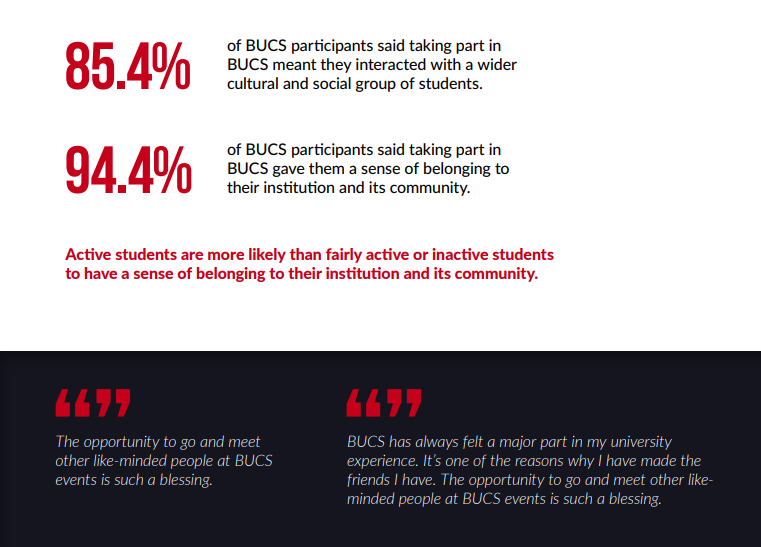
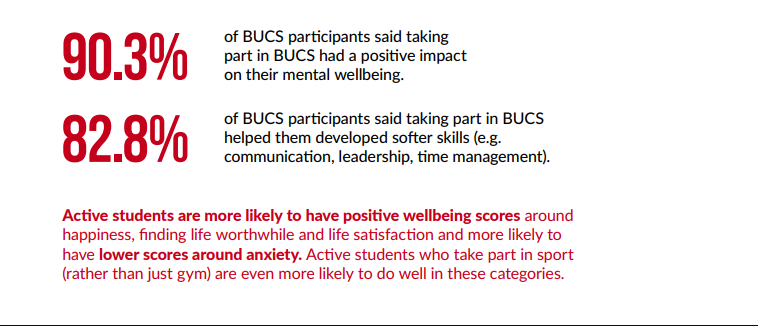
The findings informed the design of this year’ PA delivery. This nomination largely focuses on how we adapted to engage postgraduate (PG)students given 56% of PGs said they wanted to be involved but weren’t. UCL students’ mental wellbeing scores are consistently worse than thenational average, with the biggest % difference for anxiety. Our study showed that students who engaged in our offer scored significantly higherfor mental & physical wellbeing compared with unengaged or interested students. Active students reported higher levels of happiness & lifesatisfaction.
This insight has seen PA recognised throughout UCL as a key behaviour change mechanism for turning interested students into casual participantsand its vital role in addressing their student wellbeing crisis. Given the importance placed on making friends UCL worked to facilitate includingactivator-led trips to the cafe after running groups & social events like Galentines Day pilates. 33% PGs said activity conflicted with having a job,and commuting. They wanted to take part in activities with students of a similar age. PG taught students (more likely to live on/near campus) haddifferent needs to PG research (more likely to commute). This informed our 24.25 class timetabling, where we have dedicated PG-only classesearly AM, lunch & early evening to fit a commuter schedule. We expanded our class timetable to a 7-days to address feedback that PGT studentswanted weekend activity.
Case Study: BUCS Active Wellbeing Funded Project
Canterbury Christ Church University - Live Well
LiveWell is an active living programme designed to help students and staff at Canterbury Christ Church University (CCCU) with stress, low self-esteem, anxiety, or a persistent low mood. The 6-week LiveWell programme provides a hands-on opportunity for students and staff to develop an understanding of how an active lifestyle can improve physical and mental wellbeing. CCCU has documented a 24% rise in mental health referrals to Student Wellbeing Services since 2020 and within the last year, the University’s Occupational Health team have recognised 51% of referrals are mental health-related, which surpassed reported musculoskeletal issues at 31%.
“We aim to take a positive and educational approach to the term ‘being active’; with the aid of BUCS funding, we will work in partnership across the University to help those in our community who are experiencing low mental wellbeing. LiveWell will provide the participants with the tools to help get them active and teach a holistic approach to wellbeing."
For more information on BUCS, please contact [email protected]